Labor and Sex Trafficking Among Homeless Youth: A Ten-City Study
Between February 2014 and June 2016, researchers from Loyola University New Orleans’s
Modern Slavery Research Project (MSRP) were invited by Covenant House International and
ten of their individual sites in the United States and Canada to serve as external experts
to study the prevalence and nature of human trafficking among homeless youth aged 17
to 25. MSRP researchers interviewed 641 homeless and runaway youth who access services
through Covenant House’s network of shelters, transitional living and apartment programs,
and drop-in centers.
Youth were invited to participate, on a voluntary basis, in a point-in-time
study about work experience. Semi-structured interviews were conducted using the Human
Trafficking Interview and Assessment Measure (HTIAM-14) to assess whether youth had been
trafficked for sex or labor in their lifetimes.
Youth were interviewed in the following cities:
Anchorage, Alaska;
Atlanta, Georgia;
Detroit, Michigan;
Fort Lauderdale, Florida;
Los Angeles, California;
New Orleans, Louisiana;
Oakland, California;
St. Louis, Missouri;
Toronto, Ontario;
Vancouver, British Columbia.
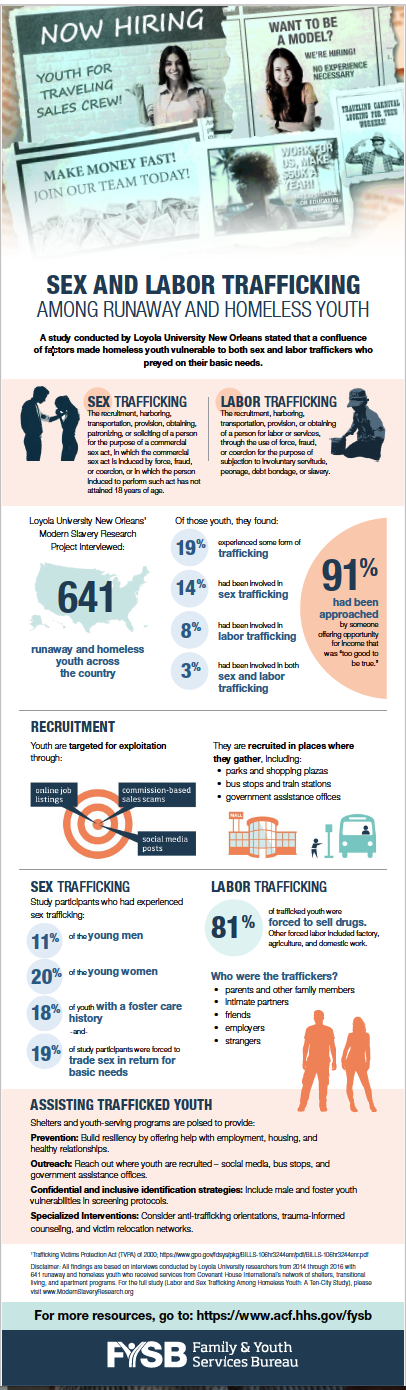
Of the 641 youth interviewed at Covenant House sites around
the United States and Canada, nearly one in five (19% or 124) were
identified as victims of some form of human trafficking, following
the legal definition outlined by the U.S. Victims of Trafficking and
Violence Protection Act (later renamed the Trafficking Victims
Protection Act (TVPA).
More than 14% (92) of the total population had been trafficked for
sex, while 8% (52) had been trafficked for other forced labor. 3%
(22) were trafficked for both sex and labor.
Ninety-one percent (91%) of the respondents reported being
approached by someone who was offering an opportunity for
income that was too good to be true. This included situations that
turned into trafficking as well as other offers for commercial sexual
exchanges, fraudulent commission-based sales, credit card scams,
stolen phone sales, and check fraud.
Make it stand out
Whatever it is, the way you tell your story online can make all the difference.